1
Snow Accumulates
Snow and ice collect on the roof surface during winter weather. Smooth, coated metal roofing can become particularly prone to sudden snow release.

Metal Roof Snow Retention Guide
Roof spikes are more commonly known as snow guards or snow stops. They help control accumulated snow and ice on sloped roofs so it does not suddenly release in a large, dangerous slide.
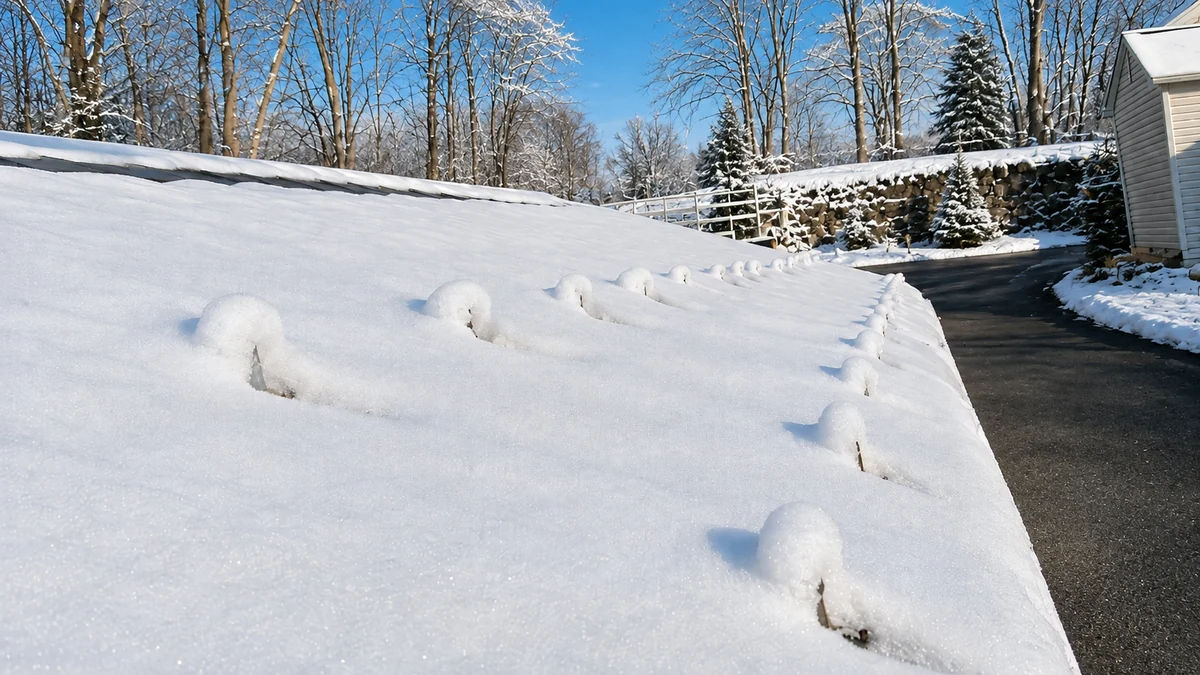
Although people may search for products such as roof spikes, the roofing industry commonly refers to these devices as snow guards, snow stops or snow-retention systems.
These rooftop devices are used primarily on sloped roofs in areas where winter precipitation can accumulate. Smooth metal roofing can allow accumulated snow and ice to release suddenly. When a large mass begins sliding, it can create a hazard at the roof edge.
A properly selected and installed snow-retention system helps manage this movement. Instead of relying on a small number of devices to catch an already-moving mass of snow, an effective system is designed to help keep the snow load distributed across the roof.
Snow retention is most effective when snow and ice are controlled before they gain momentum. The objective is not to create an indestructible barrier at the bottom of the roof. It is to distribute the forces generated by accumulated snow across an appropriately designed system.
Snow and ice collect on the roof surface during winter weather. Smooth, coated metal roofing can become particularly prone to sudden snow release.
Properly positioned snow guards or snow-retention rails help resist downhill movement before the accumulated snow develops significant momentum.
The retained snow can melt naturally or leave the roof in smaller amounts rather than releasing suddenly as one large sheet.
A sudden roof snow slide can affect people and property below the eave. Areas of concern commonly include entrances, sidewalks, driveways, parking areas, landscaping and mechanical equipment.
Sliding snow and ice may also affect gutters, windows, exterior walls, roof penetrations, HVAC equipment and lower roof sections.
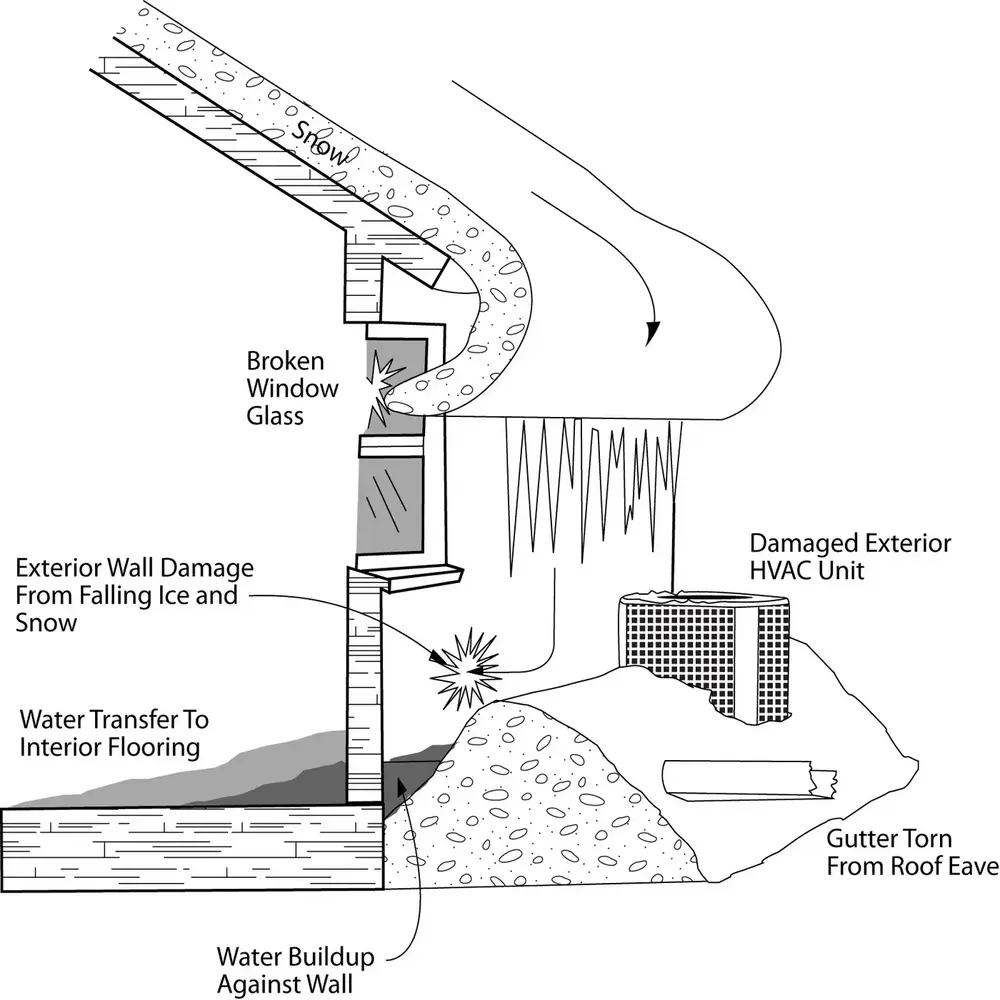
Uncontrolled snow and ice can damage building components and property below the roof edge.
Not every snow guard can be installed on every roof. Before choosing a product, identify the roofing system and exact panel profile.
Standing seam roofs use concealed fasteners and are designed to accommodate panel movement. Snow-retention options can include compatible seam clamps or approved adhesive-mounted guards, depending on the panel profile.
Screw-through snow-retention attachments should not be installed through concealed-fastener standing seam panels.
Screw-down or exposed-fastener panels may support mechanically attached snow guards and rail systems when the system is suitable for the panel and the fasteners engage adequate structural support.
Approved adhesive-mounted products may also be available for compatible panel surfaces.
One of the most important principles of roof snow retention is load distribution. A few snow guards placed only near the bottom of a roof can be exposed to far greater forces than a properly distributed layout.
Similarly, concentrating snow guards only above a doorway, vent, walkway or other isolated area may leave the rest of the roof uncontrolled.
Depending on the snow-retention system, a proper layout may require multiple rows or patterns extending across the roof and additional rows farther up the slope.
An undersized layout can concentrate loads on a small number of attachment points instead of distributing the snow load.
Installing guards only over a doorway, chimney or vent does not address snow movement across the remainder of the roof.
Attachment methods must match the roof type. In particular, concealed-fastener standing seam panels should not be penetrated with screw-down snow guards.
They serve the same general purpose but use different configurations. Individual snow guards are discrete devices positioned in a designed pattern on the roof. Snow rails or snow bars create continuous horizontal snow-retention assemblies.
The appropriate approach depends on the roof, snow conditions, panel configuration and project requirements. Some roofs can use individual pad-style snow guards, while others may be better suited to a continuous rail system.
RoofSpike.com does not provide project-specific product selection or engineering recommendations. For detailed system information, panel compatibility and installation resources, consult SnoBlox-Snojax.
RoofSpike.com is an educational resource owned and operated by IceBlox, Inc., the company behind SnoBlox-Snojax.
The information presented here draws on extensive experience with snow guards, snow rails, metal roofing systems and roof snow-retention applications.
This website provides a general introduction to roof spikes and snow retention. For detailed product information, compatibility data, spacing guidance and installation instructions, use the technical resources provided by SnoBlox-Snojax.
Roof spikes is an informal term sometimes used for rooftop snow-retention devices. These devices are more commonly called snow guards, snow stops or snow-retention systems.
In many searches, yes. Someone looking for roof spikes for snow is generally describing a device intended to help control snow and ice movement on a roof. Snow guard and snow stop are the more common industry terms.
No. Snow retention is intended to control snow movement so snow can melt or release more gradually instead of suddenly sliding from the roof in a large mass.
Snow guards generally should not be concentrated only over an isolated doorway or other small area. Proper layouts distribute snow-retention devices according to the overall roof configuration.
Screw-through snow-retention attachments should not be installed through concealed-fastener standing seam panels. Compatible non-penetrating clamp systems or approved adhesive-mounted products are normally used where appropriate.
Start by identifying the roof manufacturer, panel profile, roof type, panel dimensions and attachment requirements. Then verify compatibility with the snow-retention manufacturer before choosing a system.
RoofSpike.com provides general educational information. For product selection, roof-panel compatibility, spacing recommendations, installation instructions and snow-retention products, visit SnoBlox-Snojax.
Visit SnoBlox-Snojax.com